Friday, March 6, 2015

Solar 101

Shane has been running night classes for local workers and the technicians who will be responsible for managing the system when we leave. It’s been a chance for even his team to further grow their understanding of what we are building here; how the component elements fit together like building blocks to efficiently deliver the energy capacity that is needed here. We’ve been asked by a few people to put it in writing so this knowledge can be shared. So here goes the not-too-technical guide to off-grid solar. Or the long answer to the question “so what exactly are you doing out there?”

Electricity flows like water through a system that allows you to store reserves and pump it in different directions to manage availability and meet demand. This is the starting concept for class #1.
 
Reusing panel boxes as educational supplies
Just as rainwater is captured, pumped into tanks when it’s raining and then pumped in the other direction when it is dry, so energy can be transformed and moved to where it is needed.
In our system, solar panels “catch” the sun’s energy like buckets in the rain. This energy travels along underground cables to the solar inverters that convert the energy from direct current (DC) to alternating current (AC) that we use in our homes. All this energy then goes to the multi-cluster box (MC Box) which acts like a big controlling valve at the heart of the system.  If the MC box is the heart the system the battery inverters are the brain. And one battery inverter rules them all. The master battery inverter decides where this energy goes. Direct to the village? Or if the sun is blaring and more is being produced than used, excess energy can be sent to the battery inverters that transform it back into DC, charging the batteries, which act as tanks.

At night when the sun goes down and everyone turns on their lights and start watching Masterchef Tuvalu, the master battery inverter changes the direction of flow and starts drawing that excess stored energy from the batteries and using it to power the village.

And if the Tuvaluans are unlucky enough to have a few days of torrential rain with no sunlight, the master battery inverter is clever enough to send a message to start the generator, which acts like a pump drawing another source of energy into the system.

How your Solar electricity plant works
So how will having this system change energy use on Vaitupu?

Vaitupu is currently powered by a 110kW generator, which operates 18 hours a day (from 6am to 12 midnight). Over this 18-hour period, this hungry beast consumes 250L of diesel. Over a year that’s enough for me to drive my car 1.2 million kilometres (or 60 people to drive their car 20,000kms)! And that doesn’t include the energy used to transport the diesel to this tiny remote island.

And while the village load rarely exceeds 50kW at any time, a generator this big is needed to manage peak demand in the morning when everyone’s freezers go into over-drive and to provide some redundancy. So there is a lot of diesel being burned and not all of the energy that is being produced, can be used.

The current energy load profile for Vaitupu is hinted at in paragraph above. At 6am every morning when the generator comes on, all the fridges and freezers that have slowly been thawing over the past 6 hours, turn back on. And they have to work very hard for the next few hours to cool everything back down again. Things start to settle around 11am and then there is another peak in the evening when everyone gets home, starts cooking dinner and turns the lights on. The current load profile from an average day is plotted below.

Average daily Vaitupu village energy use

Once the solar system is turned on, it is expected that the load profile will level out. There will still be a bump in the evenings but no more morning peak and less work for all those exhausted refrigeration motors; fridges will now come on for a few minutes every hour; food will stay frozen; fans will keep running overnight keeping mosquito’s at bay and visiting Kiwi’s will be able to sleep.

Back at the powerhouse, the battery state of charge will slowly go down overnight. And then when the sun comes out in the morning, the solar array will start pumping energy into the system fuelling the village and simultaneously recharging the batteries.

For the geeky geeks, here is a graph from a day last week in Pukapuka (Cook Islands); a system that Dean installed December last year. The blue line is the village load. Red line is the solar energy utilised by the system. Light blue line indicates what potential solar energy was available to harness on that day. But batteries were already charged by 11am and the system was clever enough to only draw in what was needed for the rest of the day to cover village load and keep topping the batteries up ready for the next overnight drain.


And here’s another cool graph.


Worked it out yet?

This is how energy flows through the system. Overnight, energy is being drawn from the system at a relatively constant rate and the battery state of charge slowly drops. When the sun comes up, suddenly there is a lot more energy coming into the system than going out. The batteries are charged by 11am and the solar inverters slow down the draw from the array. Throughout the remainder of the day the system draws enough energy to power the village and keep topping up the batteries. Then the sun goes down and it all happens again.

Note: each line represents a different cluster of batteries and their different rate of charge. SMA charge algorithms were charging the batteries at different rates this day.

So that was class #1. Still following? Time for class #2.

I said before that we are harnessing energy using component building blocks which allow us to package it up into the most efficiently transportable resource so that we can distribute it where it is needed or store it up to use later.

Power = voltage x current – these are our electrical basics.

Simply put, voltage is like pressure and current like flow. You can have a skinny pipe with high pressure but low flow sending the same volume of water down the line as a fat pipe with low pressure. The same applies with electricity cables. The voltage at which you choose to move electricity around has a lot to do with the cost and practicality of cable thickness.

Even working with relatively thin cables is hard work
When solar panels are connected in series, the voltage of each panel is summed together. If each panel has is rated to 34 Volts and 8 Amps, a string of 10 panels connected in series will deliver 340 Volts at 8 Amps. Connect two of these strings in parallel and you have 340 Volts at 16 Amps.

At the front end of the system on Vaitupu is the solar array comprising 1,608 solar panels. Each solar panel has a voltage of 38V and can produce a current of 8 amps at full power. The electrical configuration of the array comprises strings of 24 panels connected in series delivering 912V-open circuit voltage at 8A. These are then paralleled going into the inverter to raise the current to 32A resulting in a total solar inverter capacity of 410kW across 15 inverters.

The solar panels are connected to solar inverters. These inverters change the direct current (DC) energy from the solar array to alternating (AC) energy that can be used to power homes.
At the other end of the system is the battery bank comprising 576 2V batteries. 24 of these batteries are connected in series to produce the equivalent of a single 48V battery with a current capacity of 3,670 Ah. Two of these banks are then connected in parallel to produce a 48V 7,040 Ah battery cluster weighing just under 10T. Vaitupu has 12 of these battery clusters and is the biggest system we will build in Tuvalu.

This is what 120 tonnes of electrical storage looks like

The batteries are connected to 36 battery inverters. These inverters change the DC energy stored in the batteries into AC energy that can be used to power homes. These inverters have the technology move energy bi-directionally. They can charge the batteries when the sun is shining, or draw energy from the batteries at night to power the village.

Everything is connected to the multi-cluster box, which runs the show.

The whole system is based on series and parallel. The solar panels are connected in series and parallel to raise both the voltage and current, the solar inverters are connected in parallel. The batteries are connected in series, and then in parallel. The battery inverters are connected in parallel.

Why? Series allows us to build the voltage up high enough that transmission of the energy becomes practical; we would need a cable as thick as my leg and as heavy as a tractor to transmit 38V (and very high current) electricity from the array. And having many of the same unit running in parallel creates redundancy in the system. This redundancy means that in the event of a failure in any part of the system the system as a whole will continue to operate. It also means that this section of the system can be shut down and isolated for maintenance without having to turn the power off completely.

Just like Lego after all.

On Friday this week we have the 6th and 7th form (Year 11 and 12) physics students visiting the site. We’re excited to open the doors and let people see what is being built here. Hadley will be fielding the hard questions. 

Tuesday, February 17, 2015

A big first week on site

What a week! It feels as though an eternity has passed since the Komawai reappeared on the horizon with our two missing comrades and remaining equipment aboard. It was only 8 days ago.

The unloading process recommenced last Saturday and after almost two weeks holding our collective breath, there was a shared sigh of relief with the arrival onshore of our crates. In two of these; our much longed for food supplies. In a third; our bicycles. And last but not least, the tools we’d need to start work.

By Monday night we were loading the civil equipment for McConnell Dowell that will now go on to Nanumea including a tractor, trailer and one of the excavators. In the fading light, finally independently mobile and re-energised on spaghetti, chocolate, muesli and tinned peaches, we started to feel like ourselves again.

Finally have our transport

On site Tuesday morning, the chaos started to give way to order.  By mid-afternoon I’d realised that my most valuable tool through the months ahead is going to be my steel hunting knife that Shane made me buy the day before we left. I can tear through the most stubborn packaging tape. And I’m learning to open my own coconuts.

By Tuesday afternoon, tool boards were up, building mark-out was complete, a mountain of packaging had collected behind the powerhouse and the first battery rack jigsaw puzzle was spread across the floor. Under torchlight Tuesday night, we measured and marked drilling holes for the first array. We were underway.

Array team stalled by rain on day one

Our schedule over the next 5 months has us partially completing the system on Vaitupu before moving on to Nanumaga, Nanumea, Niutao and returning to Vaitupu late May to complete the main array. Groundwater issues discovered when clearing the site in November resulted in McConnell Dowell halting work on the main array foundation until an engineering solution is agreed with MFAT and the local Kaupule (council). The McConnell Dowell team is due back here after we leave to complete foundation works. Our hope is to have the powerhouse fit-out and smaller battery charger array complete by the time we leave here in just under 3 weeks time.

Site overview - powerhouse centre, SIC array right and main array left

And we think that is achievable. Our local workers have earned our immediate respect for their positivity and strong work ethic. By Thursday morning our team had grown from 5 to 15. And they would work 14 hours a day if we felt we could keep up with them!

In efforts to manage our enthusiastic workforce, we have split off into three clearly defined teams: Hadley’s electrical team, Roger and Marty’s array team and Heather’s battery team. Shane likes to think that we are all his team.

In the inverter corridor, Hadley has been orchestrating a fine ballet. Alongside him, File keeps asking questions about what all the equipment is and Vilium, Aneila and Paka are unflinching when told that half the inverters now have to be taken down and moved 200mm to the left (thanks to the inaccurate drawing). The electrical crew now have all the inverters mounted, the multi-cluster box in place and cable tray ready to fill. Visible progress is fast but will slow from here as they begin the complex cabling process.

Outside, camaraderie in the array team is at an all time high. Three days in and they’ve knocked up a 50kW array. Working out in the heat, regular coconut stops are essential. One of the local boys scrambles up a 20m high tree like it’s a staircase. Epati, Bean, Konza, Ety and Sammy have lanolin dripping down their arms from the freshly lubricated bolts. Dropping one in the sand earns a jibe from Roger – “fall behind and you’re next up the coconut tree”. On Monday they start tightening fastenings, grouting trestle feet and digging trenches for the cabling. Another 360kW still to go in May will be a walk in the park.

SIC array framing went up in a day

In the battery room it’s all I can do to stay one step ahead of Bob, Eddi and Puaa. When we opened the first battery rack on Tuesday my only head start was a technical drawing and some notes from Dean. I try to anticipate the next question and am grateful for their patience when I demand for the seventh time that we recheck the diagonals to make sure it’s square. It’s a slow process but they will be a well-oiled machine by rack number 12. Just in time to move onto Nanumaga and start all over again with a new crew.

Hot on their heels, the battery loading team of Peter, Fata (Greenstuff), Teanua and Polevia are carefully and steadily lifting and positioning batteries. At 200kg each, a dropped battery will crush your foot. One rack holds 48 batteries and each must be lifted into place and slid onto the rack in the right position ready for connection. The dangerous process of connecting batteries is on hold until we can clean many of the connecting cables that have corroded in transit and storage.

At the end of week 1 we have 3 ½ battery racks built, 2 ½ now stacked with batteries. The 55kW Sunny Island Charger array is up. The inverter corridor looks almost finished with 36 Sunny Island inverters, 12 battery disconnect boards, 24 Sunny Island Chargers and 15 Tripower solar inverters and switchboards all hanging. The multicluster box is in the building, cable tray is up and the real work begins tomorrow.

And in the background of all this activity, the import of what we are here to do has become evident. The ferry is running late and we’ve been on diesel rationing for a week now. Generator hours have been cut from 6am to midnight down to 8am to 10pm. But today the generator is struggling. It’s 7:30pm and it’s died for the third time today. We suspect that it won’t be coming back on again tonight.

Monday, February 2, 2015

A growing obsession with food

Once the ferry leaves, Vaitupu is almost a closed system for another month. Except for fish, all food is now either packed into the shelves of the six little stores across the island, growing 20m up in the air or scampering through the underbrush foraging for scraps.

Our starting frame of reference is New World or Countdown – 20 isles filled with every conceivable packaged food, more than 100 different types of bread, fresh fruit and vegetables transported from every corner of the globe, a meat isle so large that the chicken section alone has 7 different flavours of skewers and the sausage section offers varieties as obscure as lamb with sage and fennel. With a plastic card we can walk out of that store with almost anything our heart desires. And then go back again tomorrow to find the empty slot on the shelf full again.

As our adventure stretches into week number three, we are like newborns having to rebuild our relationship with food. Where it comes from? How it gets to us? What our bodies need to run and jump and to concentrate on site measurement calculations and precision excavator driving?

Still waiting for our crates to arrive, we’ve been emptying the stores. There is a store which stocks tinned pineapple but there are only two tins left. Yesterday the island ran out of sugar. And I think I bought the last box of Weet-Bix on Friday. The shelves are thinning out but there is plenty of rice, palm oil and grape soda. There is also jam, Sao-like crackers, sweet biscuits, tomato sauce, soy sauce, tinned mackerels and corned beef. We cannot yet bring ourselves to eat the corned beef as it looks, smells and tastes exactly how I imagine cat food to be.  And I cannot describe my excitement when I found I could buy onions and garlic – the starter and key flavouring in every meal since.

In our first days here, we treated ourselves to a sampling of the local food. A platter prepared by a local family filled with rice, breadfruit, cassava, fish and chicken, much of it cooked in generous amounts of oil. I couldn’t quite face day 3 of the same so we’ve since been trying to cook for ourselves, a task which has only been possible with the assistance of our fabulous house-frau, Lily.

Our staple dish is fried rice. Onion, garlic, rice, a tin of soggy mixed vegetables and lashings of soy sauce. It’s actually pretty good. As we start to navigate the pathways by which other food is procured, our menu expands. From the hidden freezers out the back of little stores, Lily has helped me to find chicken bits, pre-cooked pork sausages and a 2kg bag of the fattiest lamb chops I’ve ever seen in my life. BBQ’d with a side of fried rice and a glass of coconut water; we chewed every morsel off those bones in absolute silence.

The makings of "fried rice"
Lamb chops but not as I remember?

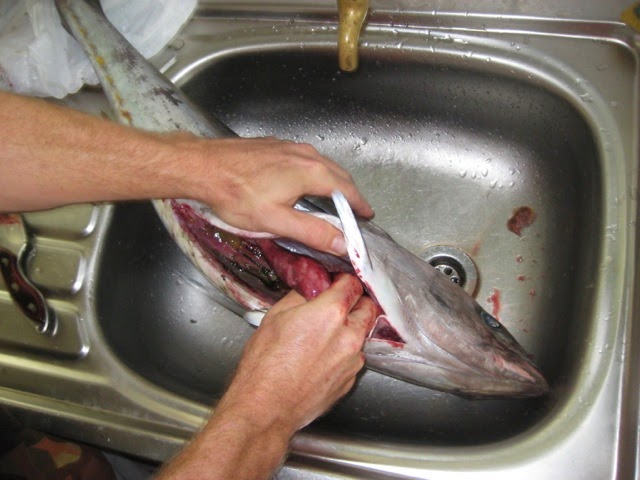
Then there is tuna. If the weather is good, local fishermen will head out early and can be intercepted at the harbour about 7am. At $2/kg, the freshest tuna I’ve ever eaten is also the cheapest. We managed to get a 7kg tuna last week. Roger enjoyed every minute watching my butchering the poor thing into steaks. There was a handsaw involved. We were still eating tuna and breadfruit fishcakes 4 days later – Lily’s special recipe.

Gutting our tuna
Lily preparing breadfruit for her fishcakes

And so while the cupboards look bare, we are far from starving. Each new ingredient that we come across is worthy of celebration. There is bread baked on the island; “donuts” would be a more accurate description. The day I found a bottle of tomato sauce coincided with our first sampling of Lily’s fishcakes. Today I discovered the last jar of vegemite on the island and lunch was different to yesterday and the day before. You don’t need a brimming pantry afterall.

But what we crave more than anything else is fresh fruit and vegetables.

Last Wednesday Lily produced a pawpaw from her garden. I’d seen a few trees around and had been asking where I might buy one. Not easily it seems. That pawpaw tasted like a swig of cold beer after a long day herding sheep. And then on Friday she produced a bowl of bananas. We had these sliced on top of toasted slices of stale donut on Sunday morning and were sure we were brunching in a posh cafĂ© in Ponsonby. And there was a cucumber for lunch in one of those early days after we arrived. I crunched it down without a thought and only now realise I should have savoured every bite.

Stuff does grow here but it’s just not available in neatly refrigerated supermarket isles. And it may not be simply a matter of money needed to acquire it.

Vaitupu is more fertile than I’d prepared myself for. It was described to me as a sand and coral atoll with little or no soil. But the vegetation is thick and lush, bursting with ferns and vines beneath a canopy of coconut trees, breadfruit and Pandanas palms. Beyond the main village where most people live in small concrete block houses, families own a “plantation” on which they grow coconuts. A very few families also grow pumpkin, capsicum, bananas, pawpaw and even tomatoes.

It feels as though you could grow anything here

We would gladly pay $50/week to have a delivery of bananas, pawpaw, pumpkin, fresh eggs, capsicum, cucumber and tomatoes. The fact that we can’t suggests that there is no local demand for this food that might motivate someone to start producing it beyond their own needs. There are hundreds of chickens but no eggs? Is it too hard to save them from the rats? There is an agricultural centre on the island of which the locals are very proud. On it a plantation of coconut trees in neat rows… surrounded by acres of bush comprising mostly coconut trees? The only other vegetables that are grown in any quantity are taro and cassava alongside the road to the High School.

Best bananas you've ever tasted!

We’ve wondered why there isn’t more effort put to producing greater quantities of fresh produce on the island since the land is clearly fertile and the climate conducive?

But why produce what is not needed immediately or can be sold/traded for those items? Taro and cassava are vital staples in the local diet. Eggs obviously are not. And coconuts can be traded with Funafuti for money to import rice, soap, soda pop, laptop computers and Internet minutes. Coconuts travel well. Paw paw would not.

And while our being here presents a current demand for these non-staple foods, we are also a short-term market. We will be gone in a month and who will pay money for cucumber and capsicum then? In the meantime I’m thinking of putting a poster up on the wall of the guesthouse:
WILL TRADE CHOCOLATE, MULTIGRAIN BREAD AND CANNED PEACHES FOR COCONUTS, PAWPAW, BANANAS, CUCUMBER OR TOMATOES

Friday, January 23, 2015

Discharge on Vaitupu

From the air-conditioned comfort of the Powersmart offices in sunny Mount Maunganui, my eyes skim down the program schedule for and casually bypass a line that reads “discharge vessel”. I’m looking for installation period estimates so that I can quantify food supplies for the duration on each island and the magnitude of the task implied by those little words is completely lost on me.

The Komawai set off from Funafuti wharf a little after 7pm on Monday with 5 intrepid adventurers packed in a 20’ container. Departure had been delayed again at the last minute to optimise arrival into Vaitupu for Tuesday morning with a full day ahead for unloading.

The Komawai is not a big ship or a new ship and every inch of rust-riddled space was jam packed with gear. Those brave enough set up makeshift hammocks on top of the battery racks and dosed heavily on travel-calm. Roger disappeared and was found a half hour later in the galley sharing the crews’ dinner. The less forward members of the team had to make do with noodle surprise and hope they didn’t see a second time around.

Komawai II

We sat on the deck and watched the lights of Funafuti disappear into the distance as the sky darkened. With it went our last air connection to the rest of the world.

Noise on deck drew us out of various states of sleep about 6am to the sight of Vaitupu from the deck – a long thin line of lush coconut trees broken by a small concrete harbour and a half dozen fishing boats in front of a grand Church. By 8am the crew had eaten breakfast and we tossed our bags overboard, followed down a rope ladder into a dingy and were motored in to shore. Roger gallantly volunteered to stay aboard to oversee unloading.

Abandoning ship

And then began the process of discharging the vessel.

The size of the task?

The Komawai is 70m long and I would guess no more than 12m wide. It has a large hold accessed from a set of rusty steel doors at the bow of the ship. And a crane that is used to lift cargo into the hold and then onto the closed hold doors. The Komawai is carrying over 500 tonnes of gear and equipment for the solar installation component of the project. Because we are reliant on an excavator that can only lift 1 tonne at a time, there are more than 500 individual crates, pallets and bundles of gear to be discharged (many of them buried deep within the hull of the ship).

What do they have to work with?

Vaitupu is surrounded by a shallow reef that stretches about 100m from the shore. The Komawai cannot risk hitting the reef and must constantly drift or motor in deep water off shore.

Perched on the bow of the Komawai are two small lighters (about 7m x 3m), each with an outboard bolted on the back. These floating platforms are used to ferry cargo from the ship to shore.

Vaitupu has a harbour. It is about 60m wide with a narrow channel blasted through the reef to create a passage that is accessible at both low and high tide. The Vaitupu harbour has a crane that can lift cargo from the lighters onto transport to move it to site. Vaitupu is the only island with this level of infrastructure.

We are lucky to have two tractors with 3 tonne rated trailers and two 1 tonne rated excavators to lift crates from the trailers to the ground on site. When the Komawai leaves it will be taking one of the tractors and one of the excavators on to Nanumea.

How do they do it?

Individual crates or boxes are lifted from the open racks on deck by the crane. Stevedores race about on deck catching hook chains and positioning straps to each load before it is lifted into the air. Everything must be timed so that the weight at the end of the chains is lifted at just the right time so that it swings out over the water and can be dropped onto the bobbing platform below. At the same time the buoyancy of the ship and the lighter don’t match. At any moment the lighter can be 3m from the deck or 10m from the deck. Three brave souls “catch” the cargo as it is dropped onto the lighter and position it for transport to shore. Once a lighter is loaded (a precarious activity that could take more than an hour), it sets off for shore. The small lighter can carry about 7 tonne, the larger once twice that so a round trip, which could take as long as 2-3 hours might only deliver 7/500ths of our equipment to shore.

The bigger of the two lighters

Lifting onto the wharf. Komawai on horizon.

At the other end, a frantic crew position strops through the pallets so the crane can lift them directly onto the back of a trailer. On site, both excavators are lifting pallets off the trailer and carefully positioning the gear on site so that it won’t be in the way when we start work. With both trailers going, and a 1km trip to site, we had a conveyor going yesterday which was keeping up with the flow of equipment off the ship. In a full day we may have managed to unload 100 tonnes.


Our excavator masquerading as a forklift

And then just to keep us on our toes, there is the weather. Today the swell has picked up again and it is too dangerous for this precarious off-shore dance to take place. The Komawai has disappeared over the horizon to a safe distance so the captain can take a break and stop worrying about the reef. We will all be out there at 7am tomorrow morning watching for her return.


In the meantime, we are surviving on Weetabix, tuna, rice and breadfruit as our crates of food are buried in the stern of the ship and are likely to be the last items off. When they do finally arrive it will be like Christmas. 

Saturday, January 17, 2015

Final preparations in Funafuti

“Fiji Airways have a new plane!”, Alex, our Beca liaison exclaimed as we shuffled out into the muggy air at Nadi airport. From her look of relief, I wonder what the plane she travelled on in October looked like? This is our second to last jump on the trip from Tauranga to Funafuti, the capital of Tuvalu.

We make it to Suva with minimal incident. There is thick greenery below and mountains as far as I can see with a few four wheel drive tracks scrambling through it all. I wonder what the mountain biking is like in Fiji? Wet and muddy? The tractor towing our luggage trundles across the tarmac blowing black smoke and delivers our bags to a lazy-Suzan sized conveyor belt. Everyone scrambles to find their bags so they can be loaded straight back onto the plane we just jumped out of. Within 30min of landing we are in the air again.

After more than 2 hours of continuous blue ocean below, something light blue and then green appears. The outer ring of the Funafuti, Tuvaluan atoll. We are 1,000km north of Fiji surrounded by ocean. This is our last plane flight. It will be a boat from here.


Outer rim of Funafuti atoll from the plane

Funafuti is the most populated island of Tuvalu with just over 6,000 regular residents. There are two regular flights a week from Fiji. And it’s a big event. A siren sounds 30mins before the plane is due so that the volleyball nets and soccer goal posts can be moved off the runway. Everyone is out to greet new arrivals and farewell those going away to work or school (in Fiji and beyond). We are warmly greeted by Tuvalu’s MFAT representative, Mati Afelee and the Tuvaluan Electricity Corporation GM, Mafalu Lotolua.

The heat is noticeable but it’s probably only 31 degrees. The humidity is something else. We are all sweating after the 50m walk to the hotel and elated to find the air conditioners in our rooms blasting cold air (set at 17 degrees for the visitors). We progressively adjust the temperature setting up to 28 degrees over the next few days as there will be no such luxury on the outer islands. We need to acclimatize.

And it’s been a busy acclimatization period!

Shane has been fostering our network of important contacts. These are the people we are going to rely on for support over the next 5 months as we juggle people movements, shipments of equipment, access to port real-estate, customs and quarantine, food and fresh water supplies and cultural sensitivities with our fingers forever crossed that the internet will work today.

And Roger already has a “coconut man”! A friendly fellow at the end of the island who makes model houses and boats to sell at a craft stall when the plane comes in, but whose job this week is to climb trees and collect coconuts for Roger. I think Roger has made more friends so far than the rest of us combined!


Roger and friends playing with his new iPad

And there has been plenty of time to frantically scour the local shops for last minute forgotten items. But it’s not shopping as we know it. The shelves in the small stores are loaded with tinned and packaged goods, the freezers filled with suspicious packages of meat which may or may not be still frozen. Onions were the only “fresh” food available. We did find a hardware store which had a tarpaulin (for shade on site and to catch rainwater). And after traipsing through at least 6 stores I found a spare can opener to take with us on the boat tomorrow and an extra pair of sunglasses. If we are missing anything else on the outer islands, Funafuti is the closest source – a 3 week ferry delivery away.


Supplies available inside the local stores

But it’s not all networking and shopping sprees. We spent a day at the port trying to marry up our equipment lists and understanding of the shipping schedule with the crates and containers of PS gear which are sitting at the port. Despite the clutter and confusion, a missing (borrowed!) strap, and the fact that the fork-lift has been out of action all week because of a flat tyre, it all seems to function somehow. It impresses me that anything makes it to the end of the journey but it does.


Some of our equipment weathering the elements at Funafuti port

The boys spent yesterday making timber braces for shifting the batteries (each pallet weighing almost 1 tonne) and crates of panels. Experience from the Cooks left us with a number of damaged batteries which were crushed by the strops used to lift them from the open container onto the small lighters which are used to deliver them to shore. We will get to test out their handiwork on Monday.

We’ve also had some time to understand what other projects are underway at the moment and the context in which some of this aid work is taking place. There are 2 other solar projects happening – another funded by MFAT on the Government building and a UAE funded project next to the TEC building. Each has its own challenges – the steeply sloping 12m high rooftop of the Government building which requires everyone to operate on harnesses with edge protection, and the tidal water which keeps filling the footings next to the airport. We will have our own.

There is another solar project here on Funafuti which we explored on Thursday. In 2007, a Japanese project installed a system on the grandstand of the sports field. Containers were used in place of buildings to store the inverters. In a too short time, the containers have rusted shut, the cabling under the panels is hanging loose and some of the panels themselves are damaged. The containers were silent. As far as we can determine, the system is no longer operating. It is a reminder of how harsh the environment is but also demonstrates how key the maintenance schedule for our project will be.


The Japanese system constructed in 2007

There is another project underway to remediate the borrow pits – dug out by the Americans to construct the runway during World War II. Over the intervening years the pits have been treated as rubbish dumps with pig pens and peoples houses crowding in along the edges leaching effluent. When the tide rises, so does the level of the water in the pits leaving people clambering to stay out of the gunge. It will be an immense project to clean these up.


Borrow pits

Tomorrow afternoon we board the Komawai II, the PDL shipping vessel which arrived this morning with all our solar equipment for Vaitupu on board. It will be far less crowded than the ferry would have been (left this morning) and we will be able to leave 2 team members on board when we get to Vaitupu to help coordinate unloading. We are frantically trying to make or source fishing nets (hammocks) to sleep in tomorrow night. There are bunks in a container on board for us. But the crew seemed more than happy to relinquish these for the team? Could be that lying on a narrow bunk having your head constantly lolling from side to side and bumping against the wall or the rail isn’t recipe for good night’s sleep?

We are all anxious to begin. But just being here makes everything feel more possible than it did trying to make plans and anticipate events from New Zealand. From here on out, we must learn to work on island time.


 Every evening in Tuvalu